Reading Sami Children's Books Will Improve Your Vocabulary

Author

Reading children’s books in Sami is one of the most effective ways to build your vocabulary.
These books provide simple context clues that make learning new words feel effortless.
You’ll quickly pick up foundational nouns and verbs without needing to memorize long lists.
By combining illustrations with repetitive text, your brain naturally absorbs the language.
Table of Contents:
Why children’s books work for beginners
Children’s books use highly visual storytelling to explain what’s happening on the page.
If a page shows a picture of a bear in the snow, you can easily guess the words for “bear” and “snow”.
This visual context drastically reduces your reliance on a translation dictionary.
These books also rely heavily on repetition to keep young readers engaged.
Seeing the same words repeated page after page moves them from your short-term memory to your long-term memory.
The vocabulary used in these stories is also incredibly practical.
You’ll learn words for animals, weather, family members, and daily routines.
These are the exact same foundational words you need to start speaking Sami in real life.
Common vocabulary found in Sami children’s stories
Northern Sami is the most widely spoken regional variation, so you’ll find the most books printed in this language.
Many children’s books focus heavily on nature and animals native to the Sápmi region.
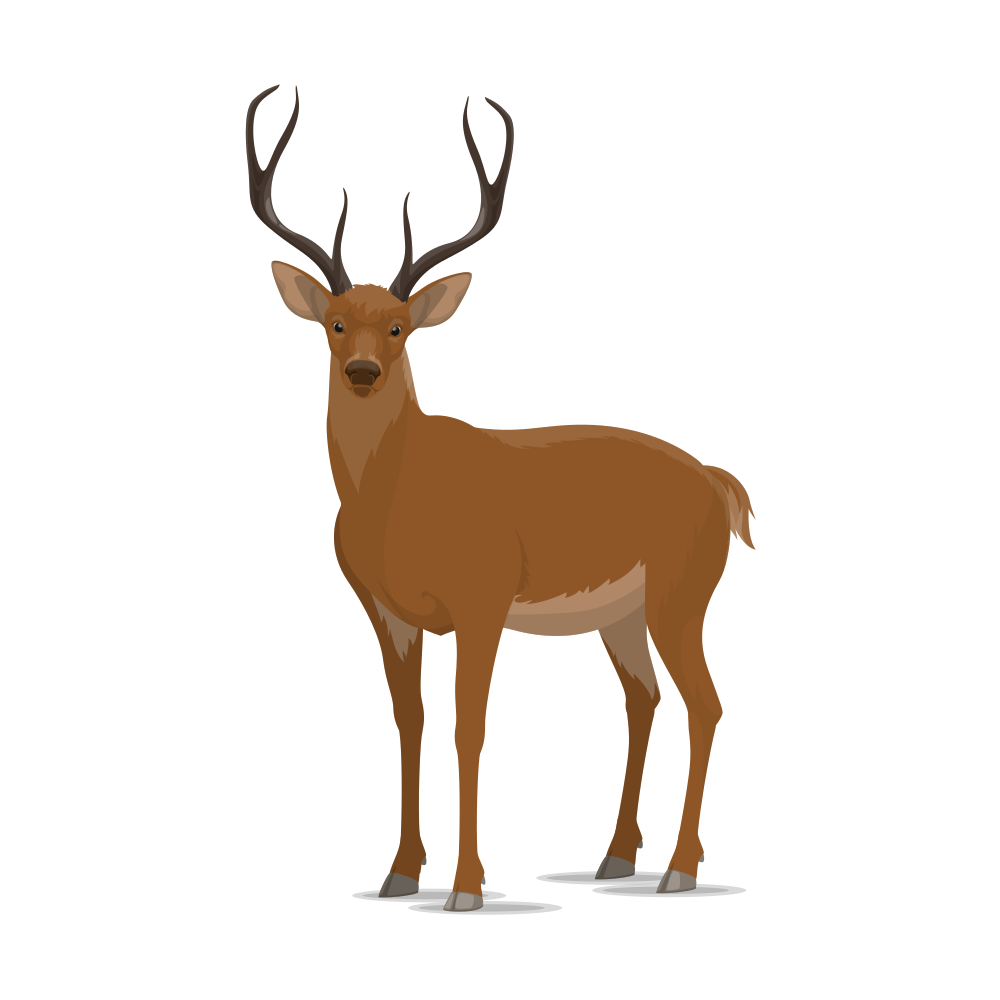
You’ll frequently encounter words for reindeer, bears, foxes, and the changing seasons.
Here’s a quick table of common vocabulary you’ll spot in almost any Sami children’s book.
| English | Northern Sami | Inari Sami |
|---|---|---|
| Bear | Guovža | Kuobžâ |
| Reindeer | Boazu | Puásui |
| Fox | Rieban | Riemnjis |
| Snow | Muohta | Muotâ |
| Sun | Beaivi | Peivi |
| Boy | Bárdni | Kandâ |
| Girl | Nieida | Nieidâ |
Simple sentence structures to look out for
Children’s books don’t use complex, winding grammar rules.
They use short, direct sentences that help you understand basic Sami word order.
You’ll often see simple subject-verb-object structures that are easy for beginners to digest.
Here are a few examples of sentences you might read in a beginner book.

Guovža oađđá.
Rieban viehká muohtagis.
Bárdni oaidná bohcco.
Notice how these simple sentences clearly connect the action to the subject.
Reading these repeatedly helps you internalize how verbs are conjugated in the third person.
Where to find Sami children’s books and reading materials
Finding physical books in Sami can be challenging depending on where you live in the world.
Fortunately, there are great digital options and specialized publishers that make these resources accessible.
The absolute best place to start reading simple, graded stories is right here on Talk In Sami.
We offer a growing library of beginner-friendly reading materials with built-in audio and translations to accelerate your learning.
If you want to buy physical children’s books, Davvi Girji is the largest Sami publisher in the world.
They offer a fantastic selection of illustrated Sami books that you can easily order online.
Another great option is Tjállegoahte, a Sami writers’ center that frequently promotes new children’s literature.
You can also explore the digital archives of the National Library of Norway, which hosts many scanned historical Sami children’s books for free.